What is Art Therapy?
For those who are asking “what’s art therapy?” I have your back. Art therapy is an integrative approach to mental health that uses art-making and the creative process, as well as psychological theory and human experiences within a therapeutic relationship. I always say that art therapy has three basic functions:
- It provides an ice breaker or a buffer during therapy because sometimes therapy is awkward. Art can help alleviate that.
- It is a stress reliever. It’s a way to distract the brain and focus on something else. If you’ve used adult coloring books, you’ve done a little art therapy.
- It’s a way to convey feelings that are hard to express otherwise. Sometimes language is a barrier and artistic expression can speak. Sometimes you don’t even know that you’re feeling a certain way for a particular reason. Art helps tease those things out.
But Science?
With my background in psychology, I had a hard time with the science behind art therapy. Upon conducting an independent research experiment (Weber & Amel, 2015) we found that art therapy has significant effects on an individual’s stress levels and mood. Similar studies have found the same result (Bohlmeijer et. al, 2010; Fjorback et. al, 2011).
The aspect of art therapy research that really convinced me of the science behind the process was the Expressive Therapies Continuum. The Expressive Therapies Continuum is a model that depicts different levels of cognitive processing, and incorporates the differences in functioning when either the right brain or the left brain is engaged. Typically, the left hemisphere is thought to process information in an organized, sequential, and linear manner. The right hemisphere is often seen as the emotional and conceptual information processor. Each component on the continuum is defined by the side of the brain being activated and the level of cognitive functioning being achieved.

This model is used to describe and assess an individual’s level of creative functioning based on varying aspects of their work, such as the purpose, choice of medium, interaction with the medium, and imagery used within the piece. The model also helps therapists meet the needs of clients. By examining the artwork made by a client, a therapist can assess the cognitive development of an individual and use the knowledge to develop a treatment plan that fits their needs and general capabilities. It helps therapists meet the clients where they are at.
The Expressive Therapies Continuum consists of three levels of functioning, each of which are divided by the left and right brain. Listed from simplest to most complex, the three levels include the Kinesthetic/Sensory level, the Perceptual/Affective level, and the Cognitive/Symbolic level. “As information processing increases with one component of an Expressive Therapies Continuum level, it necessarily decreases and eventually blocks functioning with the opposite component,” (Hinz, 2009).
The bipolar nature of the various levels of the Expressive Therapies Continuum, however, can provide therapeutic benefits. For example, if a client tends to be overly emotional, functioning primarily at an Affective level, it might be a good idea to introduce a perceptually driven art project. The fourth level, the creative level, can occur at any time on the continuum. Creative experiences are able to occur in either hemisphere of the brain (Hinz, 2009). In general, the goal of art therapy in regard to the Expressive Therapies Continuum would be to integrate all of the levels on the continuum as to create a satisfying and meaningful experience, however simply using the continuum to assess and describe an individual’s level of functioning is worthwhile if that cannot be achieved.
Artwork Examples from the ECT
Kinesthetic: Characterized by movement and bodily involvement in the art making process. Very process-oriented, not product-oriented.

Sensory: Characterized by the involvement of the senses (sight, smell, touch, taste, sound). Process-oriented, not product-oriented.

Perceptual: Characterized by the introduction of intentional form and shape. The focus is both on the process as well as the product. This kind of art is often found in individuals with high levels of anxiety or a need for control.
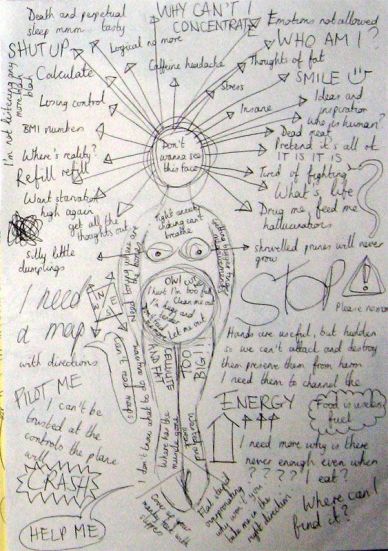
Affective: Characterized by the artwork’s reflection of inner thoughts, feelings, and emotions. Colors and shapes may be assigned values. The focus is both on the process and the product.
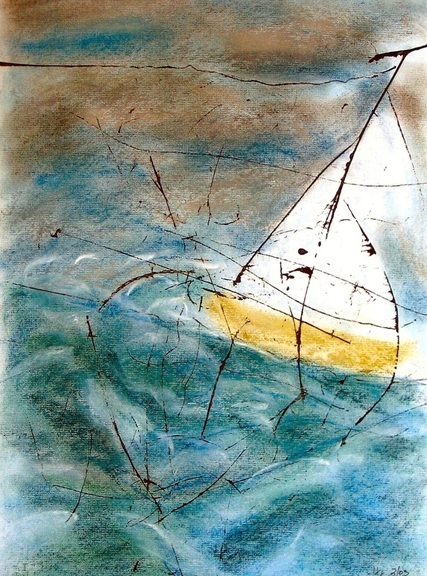
Cognitive: Characterized by concept formation, categorization, problem solving, spatial differentiation, and abstraction. Artwork becomes more complex and holds more meaning.

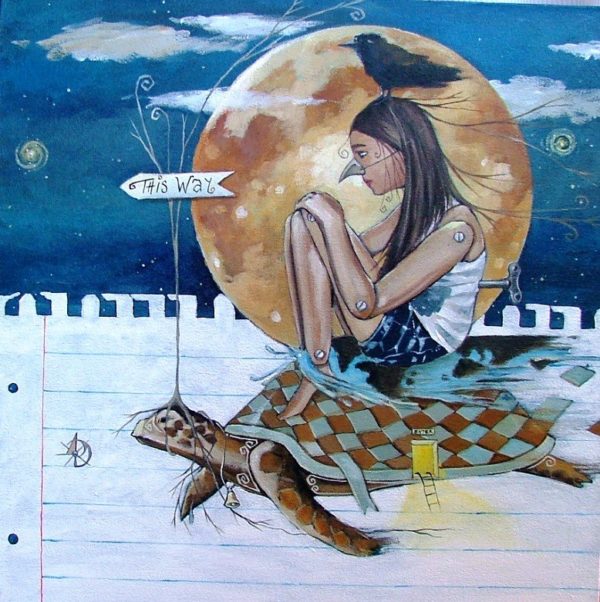
Symbolic: Characterized by the symbolism that begins to emerge in the artwork. Abstract ideas, symbolic imagery, and analogies are often found in artwork at this level.
References
Bohlmeijer, E., Prenger, R., Taal, E., & Cuijpers, P. (2010). The effects of mindfulness-based stress reduction therapy on mental health of adults with a chronic medical disease: a meta-analysis. Journal of psychosomatic research, 68(6), 539-544.
Fjorback, L. O., Arendt, M., Ørnbøl, E., Fink, P., & Walach, H. (2011). Mindfulness‐Based Stress Reduction and Mindfulness‐Based Cognitive Therapy–a systematic review of randomized controlled trials. Acta Psychiatrica Scandinavica, 124(2), 102-119.
Hinz, L. (2009). Expressive therapies continuum: a framework for using art in therapy. New York: Routledge.
Weber, R.E. & Amel, E. (2015). Manipulating art therapy: does color association have a notable effect on stress. Minnesota: Saint Paul.
 Off My Walls